
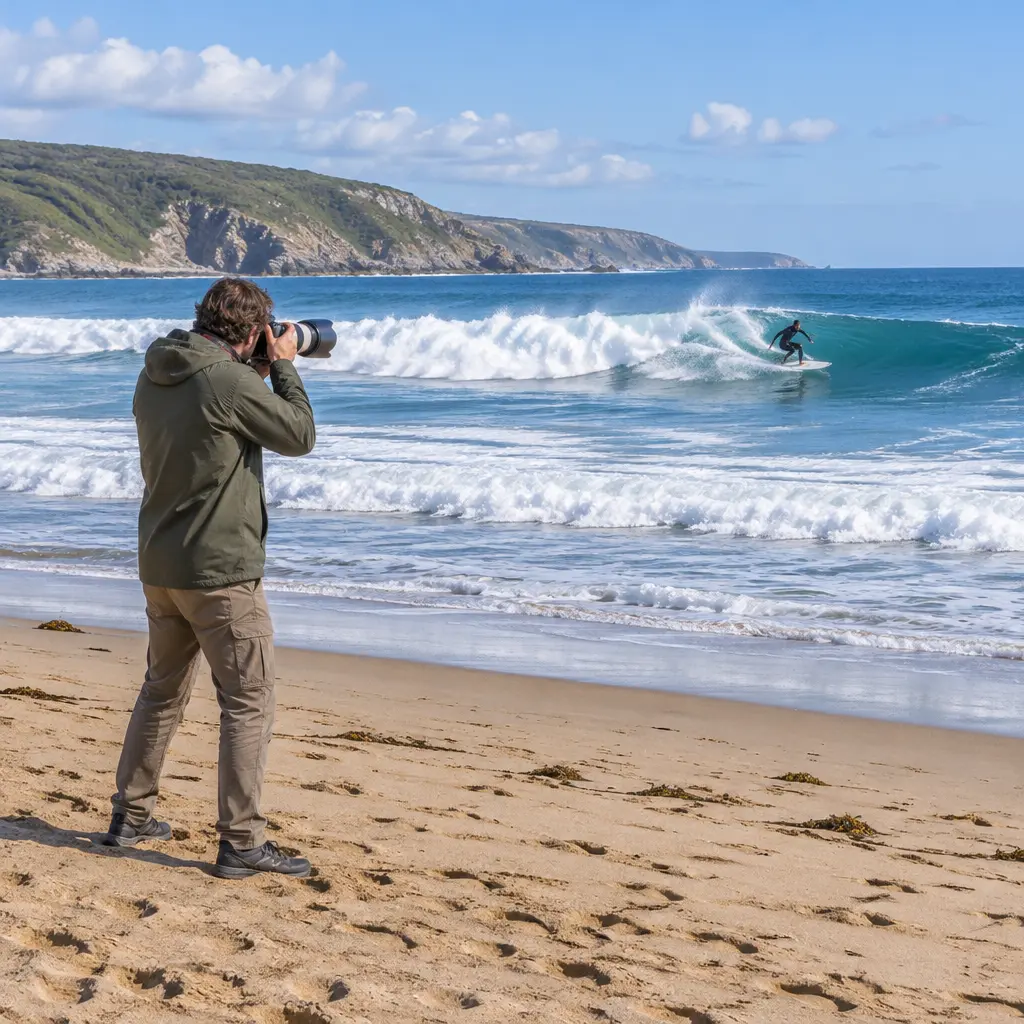
Surf photography timing is the practice of anticipating a wave’s shape and a surfer’s movement so the camera is ready at the decisive moment. Beginners can miss fewer peaks by reading sets before they arrive, tracking the surfer rather than reacting to spray, and using a short burst of frames around the maneuver. Surfline describes waves as arriving in sets with lulls between them, while World Surf League (WSL) judging criteria reward the degree of difficulty, innovation, speed, power, and flow of a ride. Together, those ideas point to a simple approach: learn the break, pre-focus, follow the line, and shoot through the action instead of waiting to see the peak happen.
Anticipating wave peaks improves surf photography timing
A wave peak is the highest or steepest part of a breaking wave, often near the section where a surfer can make a turn, take off, or enter a barrel. In photography, “anticipating the peak” means predicting where and when that section will form—not merely pointing at the surfer after the maneuver begins. The National Oceanic and Atmospheric Administration (NOAA) explains that wave behavior depends on factors such as wind, water depth, and coastal shape; at a surf break, those conditions help determine where waves steepen and break.
Timing matters because many defining actions last only a fraction of a second. A camera’s burst mode can record several frames in quick succession, but the exact frame rate depends on the camera and settings. For example, Canon lists the EOS R7 at up to 15 frames per second with its mechanical shutter and up to 30 frames per second with its electronic shutter under specified conditions. A high frame rate helps, but it cannot replace predicting the action: the photographer still needs to aim, focus, and begin shooting before the peak moment.
Read the break before following the surfer
A break is the location and pattern where waves become rideable, influenced by the seabed, swell direction, tide, and local conditions. Spend several minutes observing before shooting. Note where sets approach, where they begin to stand up, which way they peel, and where surfers usually take off. Surfline’s surf reports distinguish swell, wind, and tide because each can alter the quality and position of breaking waves; treat a forecast as a starting point and verify conditions from a safe vantage point.
Look for repeated visual cues: a darker band of incoming swell, a line of whitewater, or a surfer paddling toward a known takeoff zone. Waves are not identical, so use the pattern as a probability rather than a promise. If the peak repeatedly forms to the right of a landmark, frame that area loosely and be ready to adjust.
Predict the peak instead of reacting to spray
The most useful cue is often the wave’s shape before it breaks. A steepening face, a rising lip, and a surfer shifting weight or compressing into a turn can signal that the action is about to happen. Track the surfer’s path along the face and leave space in front of the direction of travel. Waiting until spray appears often means the camera is late, the subject has crossed the frame, or the most expressive body position has already passed.
A practical beginner exercise is to watch one set without taking pictures, then predict where the next wave will break. Afterward, compare the prediction with the actual peak. This builds a mental map of the break and helps separate a genuine takeoff or turn from an ordinary section of the ride.
Tracking surfer movement improves athlete timing
Athlete timing is the coordination of focus, framing, and shutter release with a surfer’s movement. The World Surf League’s judging criteria describe strong surfing through factors including commitment and degree of difficulty, innovative and progressive maneuvers, combination of major maneuvers, variety, speed, power, and flow. For a photographer, these are useful visual cues: turns, airs, tube rides, and committed takeoffs are moments worth anticipating, even though the best frame may come just before or after the maneuver’s most dramatic point.
Follow the ride’s line and preserve lead room
The ride’s line is the surfer’s route across the wave face. Pan smoothly with that route rather than making abrupt corrections after every splash. Leave lead room—the open space ahead of the moving surfer—so the image communicates direction and gives the action room to unfold. If the surfer is moving left, place them somewhat right of center; reverse the composition for a right-moving ride. This is a flexible guideline, not a rule: a deliberate tight crop can emphasize expression, spray, or a maneuver.
Use continuous autofocus, called AI Servo on many Canon cameras or AF-C on many other systems, to keep adjusting focus as the surfer moves. Select a tracking area that is manageable for the scene, and check that the active focus point is following the athlete rather than locking onto foreground water. Camera manuals differ, so test the chosen tracking mode on moving subjects before a surf session.
Choose shutter speed for the action
Shutter speed determines how long the sensor records light and strongly affects motion blur. A fast shutter can freeze a sharp turn or airborne maneuver; a slower speed can show movement in spray or water. As a starting point, try 1/1000 second or faster for fast action in good light, then review images at magnification and adjust. This is a practical guideline, not a universal threshold: distance, focal length, subject speed, and the look you want all matter.
For a moving subject, use continuous shooting in short bursts rather than holding the shutter continuously. Brief bursts conserve buffer and card capacity and make it easier to select a frame with clean posture, visible face, and balanced composition. If the camera offers a pre-release or pre-capture feature, consult the manual and test it; availability and operation vary by model.
Use a simple timing sequence
A repeatable sequence reduces last-second decisions. First, identify the likely peak zone. Next, acquire focus as the surfer approaches. Then follow the surfer’s line and start a short burst just before the expected turn, takeoff, or barrel entry. Continue briefly through the action, then pause to review and reset for the next wave.
- Watch a set and identify where waves are breaking.
- Choose one surfer and track their direction across the face.
- Prefocus or engage continuous autofocus before the key maneuver.
- Begin a short burst just before the peak action, not after it.
- Review focus, framing, and timing between waves, then adjust one setting at a time.
Equipment and practice make peak timing more reliable
Equipment supports timing but does not substitute for observation. A long lens can fill the frame from shore, while a weather-sealed camera and protective housing can help manage spray and salt exposure. The best setup depends on distance, access, light, and safety. For beginners, a secure position with a clear view of the break is more valuable than standing close to the water or using unfamiliar equipment under pressure.
Prepare camera settings before the set arrives
Set autofocus, drive mode, exposure, and image format before the action begins. In changing daylight, shutter-priority mode can keep the chosen action-stopping speed while the camera adjusts aperture; in steady light, manual exposure with auto ISO can offer consistent control. Check exposure on bright foam and reflective water, where highlights can clip easily. A fast memory card and adequate buffer help sustain bursts, but their performance depends on the camera and card combination.
If photographing from the beach, a telephoto lens can help isolate a surfer, but heat shimmer over sand or water may reduce detail. A monopod can steady a heavy lens, though it should not slow repositioning. Keep a lens cloth and protective covers available, and follow manufacturer guidance for cleaning salt spray.
Practice with a timing log and frame review
A timing log is a brief record of conditions, settings, and what happened in a sequence. After a session, compare near-misses with successful frames: Was autofocus late? Did the burst begin after the turn? Was the surfer too close to the frame edge? Write down one adjustment for the next session. This turns missed peaks into feedback rather than repeated frustration.
A useful practice drill is to photograph a predictable moving subject, such as a skateboarder on a safe, designated course or a runner passing a fixed point. Anticipate the point of action and shoot a short burst before it arrives. The same skills—tracking, panning, focus acquisition, and anticipation—transfer to surf photography without requiring a perfect swell.
Prioritize ocean and shoreline safety
Photographers should understand local hazards before choosing a position. Rip currents, changing tides, slippery rocks, shorebreak, and unpredictable waves can put people at risk. NOAA and the National Weather Service advise beachgoers to recognize rip-current conditions and follow local beach warnings; a camera should never distract from changing water or surf-zone conditions. Photograph from a stable, permitted location, keep an escape route, and obey lifeguards and access restrictions.
For water photography, use equipment designed for the conditions and do not enter the surf solely to get closer to a subject. Respect surfers’ space, avoid interfering with a ride, and follow local rules about photography and access. The safest image is not worth compromising personal safety or another person’s session.
Conclusion: anticipation turns missed peaks into learning
Better surf photography timing comes from combining wave reading with athlete tracking. Learn where the break peaks, watch the surfer’s line, focus before the maneuver, and use short bursts around the expected action. A suitable shutter speed, prepared camera settings, and regular frame review make those decisions more repeatable, while ocean awareness keeps the practice responsible. Start with one break and one timing cue, review what worked, and refine your approach session by session.
Sources: Surfline, Surf Forecasting and Surf Reports; National Oceanic and Atmospheric Administration, Ocean Waves; World Surf League, Judging Criteria; Canon, EOS R7 Specifications; National Weather Service, Rip Current Safety


