Fine art surf photography prints are photographs made and finished for exhibition or collecting, rather than simply reproduced as decorative posters. Prints that hold up in galleries combine a compelling image with a suitable printing process, stable materials, careful color management, and conservation-minded framing. Those choices matter: the Image Permanence Institute notes that light, heat, humidity, and pollutants can accelerate the deterioration of photographs and other collection materials. This guide compares print processes and substrates, explains how to assess image quality and longevity, and offers practical examples for choosing and displaying surf work.
Print Quality and Fine Art Surf Photography Choices
A fine art surf print is best understood as the complete object: the photographic image, the printing method, the paper or other substrate, the finishing, and the way the work is presented. The U.S. National Archives describes preservation as an effort to protect records from damage and deterioration; in photographic practice, that principle makes material selection and display conditions part of the artwork’s long-term quality. A striking image of a wave is not automatically a durable gallery print, just as an archival paper cannot compensate for poor image files or careless handling.
The main choices are pigment-ink printing on fine art paper, traditional photographic printing on light-sensitive paper, and specialty presentations such as printing on metal or acrylic. Each has a different surface character and display profile. The discussion below separates visual qualities from longevity claims, then connects both to editioning, framing, and real-world gallery use.
Printing Processes Define Fine Art Surf Photography Choices
A printing process is the method used to transfer a photographic image onto a physical support. The process affects tonal transitions, surface texture, color, contrast, and how the print responds to light and handling. There is no single process that is best for every surf photograph: a misty, low-contrast seascape may benefit from a matte surface, while a dramatic barrel wave may call for the rich blacks and gloss of a photographic print.
Pigment Inkjet Prints on Fine Art Paper
Pigment inkjet printing places microscopic pigment particles on a paper surface using a digital printer. It is commonly called giclée in art markets, although the term itself does not guarantee a specific standard of quality or longevity. The quality depends on the printer, inks, paper, image preparation, and production controls.
Cotton rag and alpha-cellulose papers are common choices. Cotton rag papers often have a soft, tactile surface and are frequently selected for work intended to feel painterly or understated. Alpha-cellulose papers can offer a smooth, bright surface at a different price point. Hahnemühle, a paper manufacturer, describes its fine art papers as available in a range of textures and weights; the practical lesson is to request a sample or view a finished print rather than choosing by paper name alone.
For surf photography, matte or lightly textured paper can render spray, foam, and overcast skies with a restrained, atmospheric quality. A smooth baryta-style inkjet paper can provide a brighter surface and deeper-looking blacks. Ask the printer for the exact paper and ink combination, and check whether the paper is described as acid-free or made from cotton or alpha-cellulose. These terms help identify materials, but they should not be treated as a guarantee that the finished print will last indefinitely.
Traditional Photographic Prints
A traditional photographic print is produced on light-sensitive photographic paper, commonly through a chemical process such as chromogenic color printing or black-and-white silver-gelatin printing. Chromogenic prints can deliver smooth gradients and a familiar photographic gloss or lustre. Silver-gelatin prints are valued for monochrome work and can produce a distinctive range of blacks and grays.
This route can suit high-energy surf images where crisp detail, glossy highlights, and saturated color are central to the artist’s intention. It is important to distinguish process from preservation: a print’s stability depends on the specific materials and processing quality, as well as on exposure to light, heat, and pollutants. The Image Permanence Institute’s preservation guidance emphasizes that storage and display environments influence the rate of deterioration, so a process label alone cannot predict the life of an individual print.
Metal and Acrylic Presentations
Metal and acrylic presentations are specialty display options rather than interchangeable paper processes. In a metal print, an image is often transferred to a coated aluminum panel; in an acrylic presentation, the image may be mounted behind or beneath a clear acrylic face. Both can create a sleek, contemporary look and can make blues and highlights appear especially vivid.
These formats may be appropriate for a modern surf gallery, a coastal hospitality space, or a work intended to make a bold visual statement. However, glare, reflections, edge damage, mounting hardware, and replacement options should be considered. Ask the maker how the image is produced, what protective layers are used, and whether the finished object can be repaired or replaced. A glossy surface can also reflect gallery lighting, so viewing a sample under comparable lighting is a useful test.
Image Quality Determines Fine Art Surf Photography Choices
Once the process is understood, image quality becomes the next filter. A gallery print must retain visual intention at its actual viewing distance: the wave’s form, the quality of the water, the relationship between surfer and scale, and the tonal detail in foam and shadow. A large print can magnify both the strengths of a photograph and the weaknesses of its capture or file preparation.
Resolution, Sharpness, and Viewing Distance
Resolution describes how much image detail is available for a chosen print size, while sharpness also depends on focus, lens performance, motion, processing, and the image’s intended look. A photographer should assess a file at the planned dimensions, not rely only on a camera’s megapixel count. Surf images often include fast-moving water, fine spray, and distant subjects, making focus and motion control especially important.
There is no universal pixel-per-inch threshold that guarantees a successful large print. The appropriate resolution depends on the source file, printer, paper, and how closely viewers will stand. Request a test crop at full size when a print is very large or contains intricate detail. This is particularly useful for checking a surfer’s outline, the edge of a breaking wave, and grain or noise in darker water.
Color Management and Tonal Range
Color management is the controlled translation of color between a camera file, a monitor, and a printer-paper combination. A calibrated monitor and the printer’s correct output profile help reduce surprises, but final appearance still depends on viewing light and the surface of the paper. Deep ocean blues, pale aqua, warm sunset reflections, and neutral foam can shift noticeably between glossy and matte media.
Inspect whether shadow detail remains visible in dark water and whether bright foam retains texture rather than turning into featureless white. For a monochrome surf photograph, look for smooth transitions from spray highlights to dark rocks or reef. A well-made print preserves the photographer’s intended contrast without making every image look artificially vivid.
Proofing and Edition Consistency
A proof is a sample print used to check color, crop, scale, and surface before an edition is completed. Proofing is especially valuable when an image will be printed in several sizes or on different papers. The artist can compare the same file on matte and lustre surfaces and decide which better supports the mood of the work.
For collectors, an edition should be clearly documented. The artist or gallery should state whether the work is part of a limited edition, identify the print size and process, and provide a certificate or other record where offered. Edition numbers are a matter of the artist’s chosen practice rather than a universal durability measure; consistent production and transparent documentation are the more useful signals.
Materials and Display Protect Fine Art Surf Photography Choices
A print’s gallery life depends not only on how it is made, but also on how it is handled, framed, lit, and stored. The Image Permanence Institute identifies light, temperature, humidity, and pollutants as factors that can contribute to deterioration. These risks are particularly relevant to coastal settings, where direct sun, salt-laden air, and changing humidity can challenge both artwork and framing materials.
Paper, Inks, and Material Transparency
Material transparency means that the maker can identify the print medium and the principal materials used. Ask whether the print is pigment inkjet, chromogenic, or another process; request the paper or substrate name; and find out whether the printer uses a protective coating. These details help a buyer compare works on more than appearance alone.
Be cautious with unqualified claims such as “archival” or “museum quality.” Such phrases are not, by themselves, a complete specification. A more useful answer identifies the process and materials and explains the recommended display conditions. For a valuable work, retain the invoice, edition information, care instructions, and any available technical documentation.
Framing, Glazing, and Light Exposure
Conservation-minded framing separates the print from damaging contact and limits exposure to dust and pollutants. A mat or spacer can keep the artwork from touching the glazing, while suitable backing and sealing help reduce environmental exposure. Ask a qualified framer about materials appropriate for photographs and about glazing that filters ultraviolet radiation.
Ultraviolet-filtering glazing can reduce one part of light exposure, but it does not make a print immune to fading. Visible light can also contribute to change, so the National Park Service’s museum guidance to limit light exposure is relevant beyond museum collections: avoid prolonged direct sunlight and intense spotlights. For a gallery wall, use controlled lighting and rotate sensitive works when practical.
Humidity, Temperature, and Coastal Rooms
Relative humidity is the amount of water vapor in the air compared with the maximum amount the air can hold at that temperature. Large or rapid changes can stress paper, adhesives, frames, and mounted panels. In a beach house or coastal gallery, avoid placing a print directly beside a window, exterior door, kitchen, or bathroom where sunlight, condensation, or moisture may fluctuate.
The Library of Congress preservation guidance recommends stable environmental conditions for collections and notes that excessive humidity can encourage mold and material damage. A practical approach is to keep framed work in a stable interior location, monitor damp rooms, and use a qualified framer for valuable pieces. In a salt-air environment, inspect frame hardware and edges periodically for corrosion or moisture-related changes.
Selecting Fine Art Surf Photography Choices for a Gallery
A gallery-ready selection balances the image’s emotional impact with its physical presentation. The best choice is not necessarily the largest or glossiest print; it is the one whose process, surface, scale, and framing reinforce the photograph while fitting the conditions in which it will be displayed.
Match Surface to Subject and Mood
A soft matte paper can support a quiet dawn image, foggy coastline, or minimalist wave study by reducing reflections and emphasizing subtle tonal shifts. A lustre or baryta-like surface can suit a high-contrast action image where crisp water detail and strong blacks are central. Metal or acrylic may work for a vivid, graphic composition, provided the lighting does not create distracting glare.
Consider the whole gallery context. A row of highly saturated glossy prints can feel cohesive in a contemporary space, while a restrained collection on textured paper may better suit a contemplative exhibition. View samples side by side under the approximate lighting planned for the room before committing to a full edition.
Choose Scale for the Viewing Environment
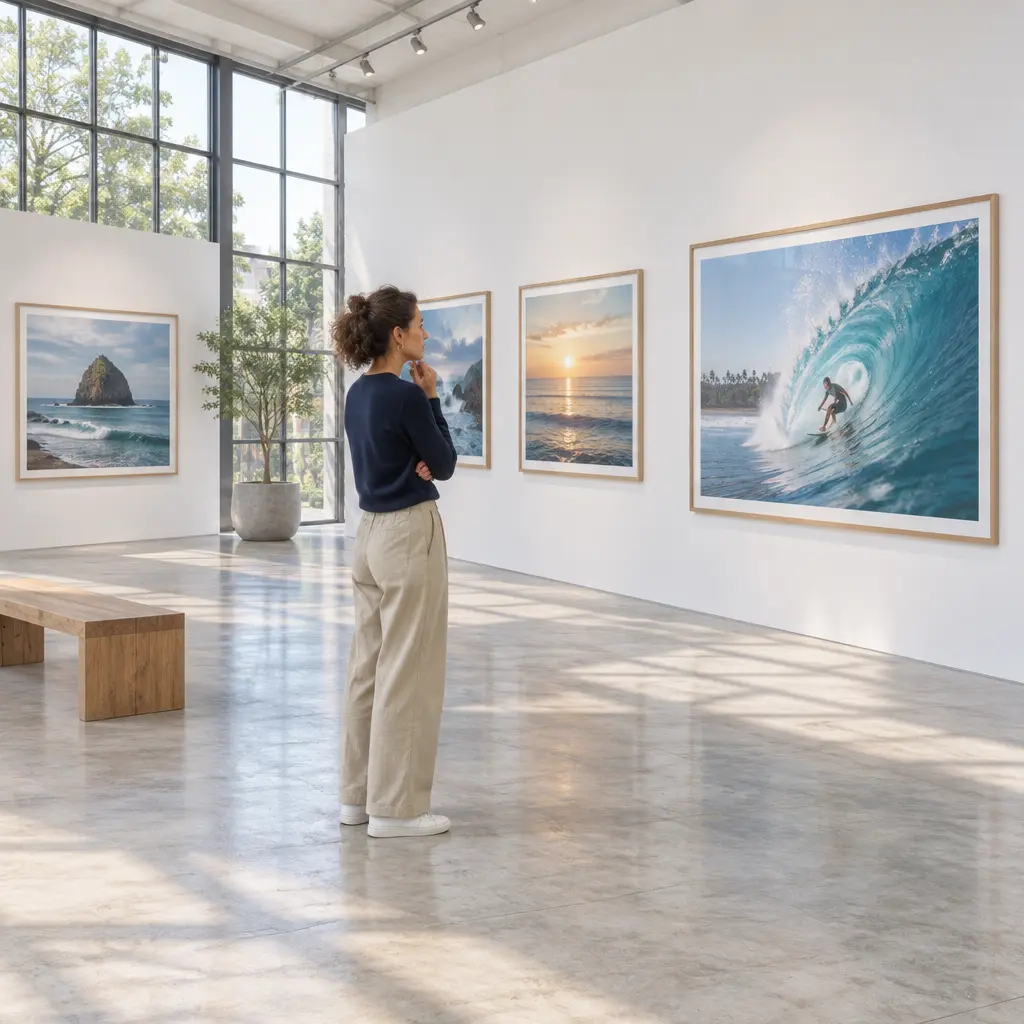
Print size should reflect wall space, viewing distance, and the image’s level of detail. A large wave can create an immersive focal point in a spacious gallery, while a smaller print may invite closer inspection of spray and texture. Before ordering, measure the wall and consider the frame’s outer dimensions, not just the image area.
Use a paper mock-up or removable outline on the wall to judge scale. For an unusually large work, ask to review a full-size detail crop and confirm that the image remains convincing from both near and far. This avoids treating size as a substitute for resolution or composition.
Compare Total Cost and Care Requirements
The purchase price is only part of the gallery cost. Include framing, glazing, mounting, installation, insurance where relevant, and any special handling. A framed paper print may require careful glazing and matting; a panel print may require secure mounting and edge protection.
Ask the gallery or artist for written care instructions and clarify whether the work is sold framed or unframed. If the print is intended for a commercial space with strong daylight or heavy traffic, prioritize controllable lighting, safe mounting, and a display plan that reduces exposure and accidental contact.
Real-World Applications of Fine Art Surf Photography Choices
The same surf image can be presented differently depending on its setting. These examples show how process, surface, and environmental conditions shape practical decisions without implying that one medium is universally superior.
A Coastal Gallery Exhibition
For a gallery showing a sequence of breaking waves, the curator might select pigment prints on a consistent paper to maintain a unified surface and color response. Test prints can reveal whether the darkest water holds detail and whether spray remains distinct under gallery lighting. A conservation-aware framing plan and controlled illumination help the series remain visually consistent during the exhibition.
A Collector’s Beach House
A collector displaying a surf photograph in a beach house should consider sunlight, humidity, and salt air before choosing the wall. A framed print on paper can be placed on an interior wall away from direct sun and moisture; a panel presentation may be considered where a frameless look is preferred, but its mounting and surface still need protection. In either case, the owner should follow the maker’s care instructions and inspect the work periodically.
A Hospitality or Public-Facing Space
Hotels, restaurants, and offices often need durable, easy-to-clean presentation and secure installation. A glossy or panel-based print can be visually forceful, but reflections from windows and overhead lighting may reduce legibility. A sample installed in the actual space can reveal glare, scale, and color issues before a larger purchase. For high-traffic areas, professional mounting and a clear replacement or maintenance plan are sensible parts of the selection.
Conclusion: Fine Art Surf Photography Choices That Last
Fine art surf photography holds up in galleries when image quality, print process, materials, and display conditions are considered together. Pigment prints offer broad paper and surface choices; traditional photographic prints provide a distinct photographic finish; and metal or acrylic presentations create contemporary effects with their own glare and mounting considerations. Resolution, color management, proofing, transparent material information, and careful framing all help ensure the finished work reflects the photographer’s intent.
Environmental care matters just as much as production. Light, humidity, temperature, and pollutants can affect photographic materials, so choose a stable location, use appropriate framing, and limit direct sunlight. Before buying, ask the artist or gallery about the process, paper or substrate, edition documentation, care requirements, and available proofs. Comparing samples and planning the display in advance are simple steps that help a surf photograph remain compelling long after its first exhibition.
Sources: Image Permanence Institute, Graphics Atlas and preservation resources, https://www.graphicsatlas.org/; U.S. National Archives, Preservation, https://www.archives.gov/preservation; Library of Congress, Caring for Your Collections, https://www.loc.gov/preservation/care/; National Park Service, Museum Handbook, Part I: Museum Collections, https://www.nps.gov/museum/publications/MHI/CHAPTER7.pdf; Hahnemühle, FineArt papers, https://www.hahnemuehle.com/en/digital-fineart/fineart-media.html